

Most Dense Form Of Water
Lesson Overview for Teachers
View the video below to see what y'all and your students will do in this lesson.
Objective
Students will be able to explain that the density of a liquid has to do with how heavy information technology is for the sample size. Students will too be able to explicate that if a liquid is more dense than water, it will sink when added to water, and if information technology is less dense than water, it will bladder.
Key Concepts
- A liquid, merely like a solid, has its own characteristic density.
- The density of a liquid is a measure of how heavy information technology is for the corporeality measured. If yous weigh equal amounts or volumes of two unlike liquids, the liquid that weighs more is more dense.
- If a liquid that is less dense than h2o is gently added to the surface of the water, it will bladder on the h2o. If a liquid that is more than dense than h2o is added to the surface of the water, information technology will sink.
Notation: Nosotros are purposely using the terms "size" and "amount" instead of "volume" in this lesson almost density. We are also using "heavy", "light", and "weight" instead of "mass". If your students have already learned the meanings of volume and mass, y'all can easily use those terms to define density (Density = mass/volume), then use those terms in this lesson.
NGSS Alignment
- NGSS 5-PS1-3:Make observations and measurements to identify materials based on their properties.
Summary
In the previous lesson, students learned that density has to exercise with how heavy an object or substance is relative to its size, and that density determines whether an object sinks or floats. Students as well observed that y'all can compare the density of a substance to the density of water by comparing the weights of equal amounts of the substance and water using a balance.
In this lesson:
- As a demonstration, the teacher will compare the weight of an equal amount or volume of h2o and corn syrup and then students tin can observe that corn syrup is more than dense than water and sinks.
- Students will compare the weight of an equal amount or volume of water and vegetable oil and see that vegetable oil is less dense than water and floats.
- Students add corn syrup to layered oil and water and run into the corn syrup sinks below both the oil and water.
Evaluation
Download the educatee activeness sheet (PDF) and distribute one per student when specified in the activity. The action canvass volition serve as the Evaluate component of the 5-E lesson plan.
Safety
Make certain you and your students wearable properly plumbing fixtures safety goggles. Isopropyl "rubbing" alcohol is a flammable liquid. Proceed away from heat, sparks, open flames, and hot surfaces. Isopropyl alcohol is besides irritating to eyes and skin, and may crusade drowsiness or dizziness if inhaled. Work with isopropyl alcohol in a well-ventilated room. Read and follow all warnings on the label.
Clean-up and Disposal
Remind students to launder their hands after completing the activity. All common household or classroom materials can be saved or disposed of in the usual way.
Materials
- Water
- two Clear plastic cups
- Corn syrup (Karo syrup), ane loving cup
- Food coloring
- Popsicle stick or plastic spoon
- Vegetable oil
- Isopropyl "rubbing" alcohol (lxx%)
- Ice cubes
- Residual
Teacher Preparation
Pour 50 mL of corn syrup, 50 mL of water, and fifty mL of vegetable oil into three plastic cups for each group.
Note: Corn syrup and vegetable oil can be difficult to clean out of graduated cylinders. To avoid this mess, measure out and pour 50 mL of h2o into each of three plastic cups. Then marking the exterior of each cup to indicate the level of the liquid in each loving cup. Pour out the h2o from two of the cups and dry the inside with a paper towel. Next, apply those cups to measure the amount of corn syrup and vegetable oil for each group. Add together 1 drop of nutrient coloring to the corn syrup.
Each group will need 50 mL of corn syrup, l mL of water, and 50 mL of vegetable oil in separate cups.
For the sit-in, you will need 50mL of water and 50 mL of corn syrup (colored with 1 drib of nutrient coloring) in separate cups.
Appoint
1. Do a demonstration to compare the density of corn syrup and water.
Materials for the sit-in:
- H2o in a clear plastic cup
- ¼ cup corn syrup (Karo syrup) with nutrient coloring in a clear plastic cup
- Popsicle stick or plastic spoon
- Graduated cylinder or chalice
- Balance
Procedure
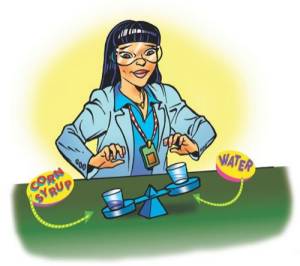
- Hold up two cups and tell students that you take water in one cup and the same corporeality or volume of corn syrup (colored blue) in the other loving cup.
- Place the cups on contrary ends of a rest.
Expected results
The corn syrup is heavier, which shows that it is more than dense than water.
Ask students:
- Since we weighed equal amounts and the corn syrup was heavier, is h2o or corn syrup more dense?
Corn syrup is more than dense than water.
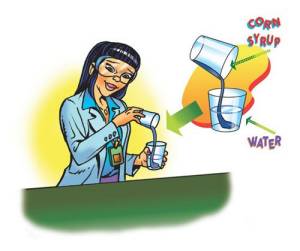
- Predict what volition happen if we pour the corn syrup into the water. Will the corn syrup float or sink when added to the h2o?
The corn syrup should sink in the water.
- Pour the colored corn syrup into the cup containing water to encounter if the corn syrup floats or sinks in the water.
Expected event
Information technology will sink. The corn syrup sinks in the h2o.
Give each pupil an Activity Canvas (PDF).
Students volition tape their observations, and answer questions about the activeness on the activity canvas.
Explore
two. Take students compare equal volumes of water and vegetable oil and exam whether the oil floats or sinks when added to water.
Question to investigate: Is vegetable oil more or less dense than water?
Materials for each group
- fifty mL of water in cup
- 50 mL of vegetable oil in cup
- 50 mL of corn syrup in cup
- Balance
Procedure
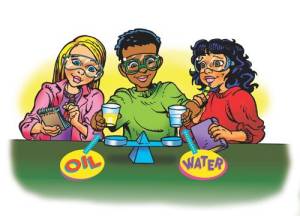
- Place the cups of water and vegetable oil on opposite ends
Expected results:
The oil weighs less (is lighter) than an equal volume of water.
Inquire students:
- Which is less dumbo, h2o or vegetable oil?
The vegetable oil is less dense than water because information technology weighs less than an equal volume of h2o.
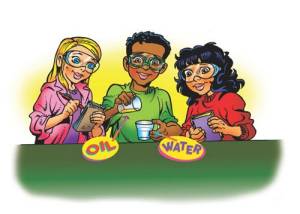
- Predict what will happen when you pour the vegetable oil into the water. Will the oil sink or float?
The oil will float on the water.
- Pour the vegetable oil onto the water to encounter if it sinks or floats.
Expected results:
The oil floats in a separate layer on the water.
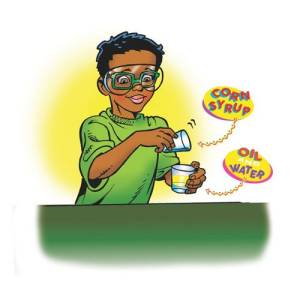
3. Have students pour colored corn syrup into the oil and water.
Explain to students that that they have discovered that vegetable oil is less dense than h2o, and that the corn syrup is more than dense than h2o.
In i hand, hold up a loving cup containing vegetable oil floating on water, and in the other hand, hold up a loving cup containing colored corn syrup.
Inquire students:
- Predict what will happen if you lot pour the corn syrup into the vegetable oil and water.
The corn syrup should sink to the bottom because it is the nearly dense.
- Pour the corn syrup into the loving cup with oil floating on h2o.
Expected results
The corn syrup will sink through the oil and water resulting in three distinct layers in the cup. In that location volition be oil on meridian, h2o in the middle, and corn syrup on the lesser.
Explicate
4. Use an animation to review and explicate pupil observations.
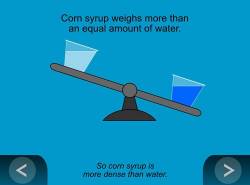
Show the Blitheness Density of Liquids.
Explain that to compare the density of corn syrup and water you can compare the weight of equal volumes of water and corn syrup. Since the aforementioned volume of corn syrup is heavier than water, it is more dumbo and sinks in water. Explain that to compare the density of oil and h2o you need to compare the weight of equal volumes of water and oil. Since the oil is lighter, it is less dense than water and floats on water.
Extend
five. Do a sit-in to compare the density of water and isopropyl booze.
Materials for the demonstration
- 2 clear plastic cups
- Water
- Isopropyl "rubbing" alcohol (70%)
- 2 ice cubes
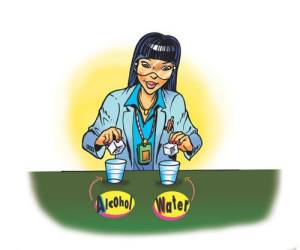
Procedure
- Label one loving cup H2o and the other Booze. Pour water and isopropyl alcohol into their labeled cups until each is nigh ½ full.
Testify students the two liquids and signal out that they look very similar. - Equally students sentinel, place an ice cube in each liquid.
Expected results
An water ice cube floats in water simply sinks in booze.
Ask students:
- Practise you call up h2o and isopropyl alcohol have the aforementioned density or different densities?
The liquids must accept unlike densities because the ice cube floats in one but sinks in the other.
Explain that since ice floats in h2o, liquid h2o must exist more dense than ice. Since water ice sinks in isopropyl alcohol, alcohol must exist less dense than ice. This ways that water and isopropyl alcohol must accept unlike densities and that the water is more dense than isopropyl booze.
You lot could cheque this past comparison the mass of 50 mL of h2o and 50 mL of isopropyl alcohol on a balance.
Expected results
The water volition weigh more than the same book of isopropyl booze (merely non by much).

Most Dense Form Of Water,
Source: https://www.acs.org/content/acs/en/education/resources/k-8/inquiryinaction/fifth-grade/substances-have-characteristic-properties/density-of-liquids.html
Posted by: engelsixeclog.blogspot.com
0 Response to "Most Dense Form Of Water"
Post a Comment